


Case Study
See how Contra Costa County added governed AI to a legacy animal welfare system on AWS without replacing it.
Replacing siloed, multi-screen case records that required tens of clicks and multiple searches to reconstruct a single animal's history for pathway review — the daily process in which staff evaluate at-risk animals and determine their next course of care
Organizing every pathway meeting: On Pathway, AI-Suggested At Risk, and No Recent Info
Into a single AI-powered intelligence layer, spanning animal profiles, medical treatments, behavioral evaluations, activities, and staff notes
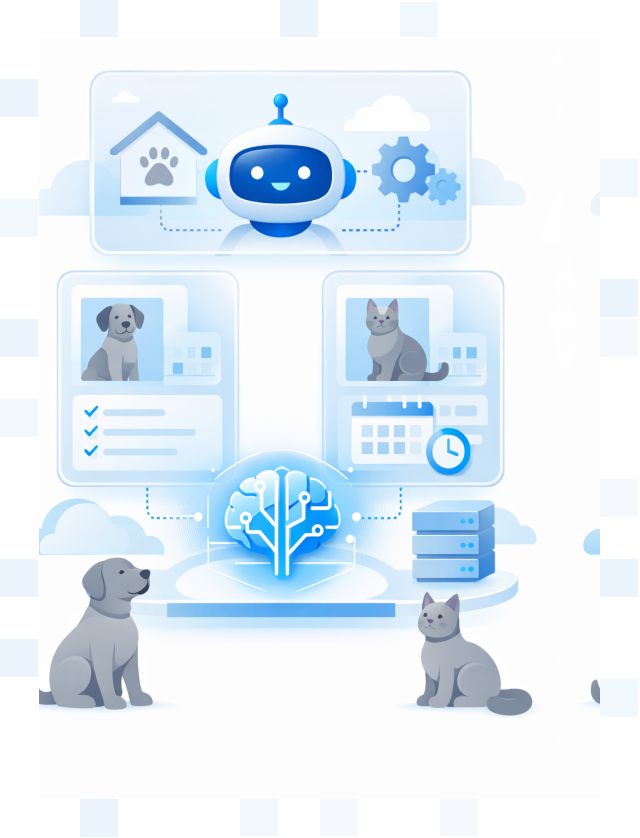
Contra Costa Animal Services Department (ASD), operating within Contra Costa County, California, manages the full spectrum of animal welfare for the region: intake, veterinary care, behavioral assessment, foster coordination, adoption, and outcome planning. At any given time, the department shelters between 300 and 400 animals, each requiring continuous review across medical treatments, behavioral evaluations, staff memos, and pathway decisions.
ASD's system of record is a legacy case management platform that reliably preserved case history but was not designed for the analytical demands of daily pathway review. In partnership with Contra Costa County's Department of Information Technology (DOIT) and AWS Partner Cloudwick Technologies, ASD deployed Amorphic Insights powered by Amazon Bedrock. The result was a mission-critical AI intelligence layer that sits above the system of record and converts fragmented case records into structured, explainable decision support. The system of record stayed in place. Amorphic Insights made it significantly more useful by adding the AI capabilities that legacy systems were never designed to deliver.
Contra Costa Animal Services operates in one of the most operationally demanding environments in county government. With a population of 300 to 400 animals at any given time, staff must continuously track intake information, medical treatments, behavioral observations, treatment history, length of stay, and pathway readiness. A pathway is the daily structured review process in which staff evaluate at-risk animals and determine the appropriate next course of care, whether that means adoption preparation, behavioral rehabilitation, medical treatment, or another intervention. These decisions require staff to have a complete, current, and accurate picture of each animal's situation.
The problem was not a lack of data. The department's mission-critical case management system, contained everything. The problem was that the data was not organized for decision support at the moment staff needed to act on it.
The existing system is a field-heavy legacy interface where information was siloed across disconnected screens. Reconstructing the full history of a single animal required navigating multiple pages, running separate search queries, and manually piecing together records that lived in different parts of the system. Critical signals — a behavioral decline, a recent medical finding, an absence of any recorded update — were frequently buried in free-text memos that were difficult to surface quickly. Generating usable reports was time-consuming and the outputs were hard to interpret.
Staff preparing for pathway meetings had to manually compile lists of at-risk animals, scan narrative notes across multiple screens, and build case context by hand before each session. There was also no systematic way to identify animals that had not received a recent update and might be slipping through the cracks. The challenge was not the mission-critical system itself. It remained essential, and replacing it was neither practical nor desirable. The challenge was that the system had no AI layer to convert its contents into decision-ready intelligence for the people responsible for acting on it every day.
Contra Costa ASD and DOIT chose Cloudwick Technologies because the approach did not require replacing any systems of record. Instead of a disruptive migration, Cloudwick deployed Amorphic Insights as a mission-critical AI intelligence layer above the existing system of record. This preserved the County's infrastructure investment while adding the AI capabilities that the current system was never designed to provide.
The solution ran within the County's own AWS environment, inside an AWS Control Tower governance structure. AWS Control Tower is AWS's framework for setting up and governing secure, multi-account cloud environments, providing centralized policy enforcement, access controls, and audit logging across all cloud activity. County-controlled IAM roles and security policies were enforced throughout. Cloudwick and AWS were granted limited access for installation, configuration, and testing only. The County retained full ownership of its infrastructure, data, and decision authority, ensuring AI was introduced inside established governance controls rather than around them.
Amazon Bedrock is the AI foundation of the solution, powering capabilities that legacy case management systems cannot deliver. These include AI-generated summarization of complex structured and unstructured case context, AI-assisted reasoning across medical and behavioral notes to identify risk signals, AI-driven prioritization of animals requiring immediate attention, and evidence-backed decision support with every output cited directly to source records.
Amazon S3 and AWS Glue managed ingestion and organization of the eight data sets provided by ASD, covering animal profiles, intake records, medical treatments, behavioral evaluations, activities, bite history, and staff memos, into a unified operational model. Amazon Athena enabled structured querying across consolidated records. AWS Lambda handled workflow execution. AWS IAM and AWS KMS enforced access control and encryption. AWS CloudTrail with Amazon CloudWatch provided the audit logging and operational monitoring required for County governance.
The staff-facing experience was organized around a three-section landing page that replaced manual list compilation before pathway meetings. The first section, On Pathway, showed animals already flagged in the systems of record for review. The second, AI-Suggested, surfaced animals not currently on the pathway but identified by Amazon Bedrock-powered reasoning based on behavioral and medical risk signals across case records. The third, No Recent Info, flagged animals with stale records, giving staff a systematic way to catch cases that might otherwise be overlooked.
From the landing page, staff could open a unified Animal Story View for each animal: a single profile combining intake details, medical history, behavioral observations, and prior pathway decisions. A 'Why Today?' panel made the AI's reasoning explicit and linked directly to the source memos, evaluations, or treatment records supporting it. An embedded research assistant powered by Amazon Bedrock allowed staff to ask natural-language questions about any animal, with every answer cited to the relevant case document.
Follow-up notes and next-review scheduling persisted across sessions, supporting continuity across daily meetings, shifts, and staff changes without reliance on printed reports or manual reconstruction.
Amorphic Insights changed how Contra Costa ASD staff engage with case data during the most operationally demanding part of their day. Pathway meetings that previously began with manual reconstruction of case histories from a multi-screen interface now start from a structured, evidence-backed animal profile.
The three-section triage view gives teams an immediate, organized picture of which animals require attention and why. It replaces the manual list-compilation and fragmented note-scanning that preceded each review. The AI-assisted reasoning layer surfaces at-risk animals based on behavioral and medical signals, reducing the risk of high-priority cases being missed. The No Recent Info section directly addresses the operational concern about animals slipping through the cracks, providing a systematic daily check for cases with stale records.
The platform preserves decision continuity across meetings, shifts, and staff changes — a meaningful improvement in an environment where case history had previously been difficult to carry forward consistently. Staff can revisit earlier pathway discussions, understand what changed between reviews, and continue from previous decisions without reconstructing the case from scratch.
The responsible AI model is explicit throughout. AI assists, surfaces, and explains, while professional judgment and final decisions remain entirely with staff. Every AI output is traceable to source records, role-based access controls are enforced, and the full audit trail is maintained inside the County's AWS Control Tower environment.
The broader lesson from this deployment is direct. Public sector organizations do not need to rip and replace the mission-critical systems they already depend on in order to add AI. By deploying Amorphic Insights as an AI intelligence layer, Contra Costa County extended the return on an existing system investment while giving staff the AI-powered decision support that modern operations require.
Contra Costa Animal Services (ASD) is the county animal services authority for Contra Costa County, California, serving a region of approximately one million residents. Founded in 1959, ASD manages the full spectrum of animal welfare across the county, including intake, veterinary care, behavioral assessment, foster coordination, adoption, and outcome planning. The department operates in partnership with Contra Costa County's Department of Information Technology (DOIT), which manages the County's technology infrastructure including its AWS Control Tower environment.