


Case Study
See how Scottsdale Fire Department used Amorphic Intelligent Automation on AWS to automate test creation, deliver instant cited answers, and modernize training operations.
Time for cited answers drawn from department manuals and SOPs
Administrators, Trainers, and Cadets — from a single unified platform
Replacing fragmented manual processes for training, assessment, and knowledge management
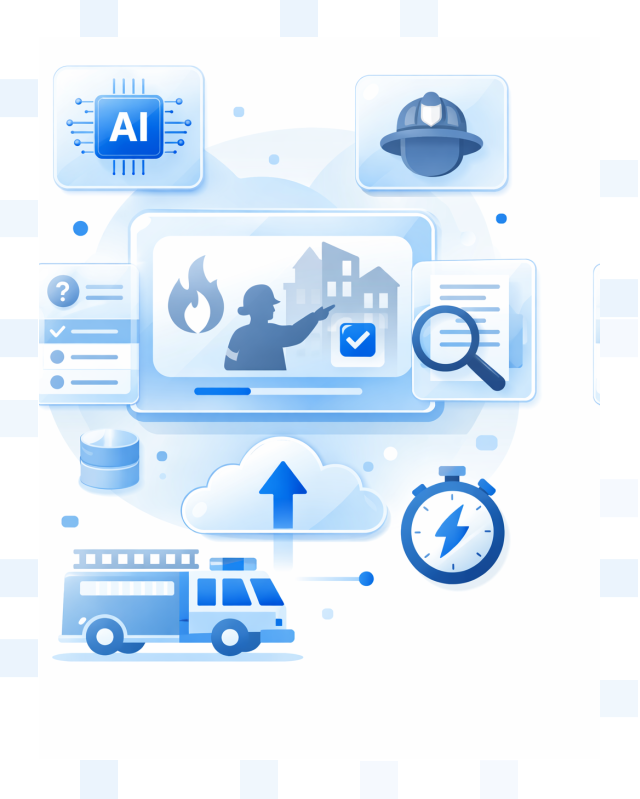
Scottsdale Fire Department, part of the City of Scottsdale's broader public safety operations, is responsible for training and certifying firefighters, cadets, and incumbent personnel across a demanding range of emergency response scenarios. Managing that training — from distributing department manuals and standard operating procedures to generating assessments and tracking readiness — relied on manual, time-consuming processes that were increasingly difficult to sustain as training complexity and content volume grew. To modernize its training operations without disrupting ongoing activities, Scottsdale Fire Department engaged AWS Partner Cloudwick Technologies to deploy a Fire Department Training and Assessment Platform built on Amorphic and AWS, and powered by Amazon Bedrock. The platform gives administrators, trainers, and cadets a unified AI-powered environment for document management, instant knowledge retrieval, automated test generation, and mission briefing creation — accessible from any standard web browser.
For the Scottsdale Fire Department, training is not an administrative function — it is a direct operational readiness requirement. Firefighters and cadets must be continuously assessed on complex department manuals, standard operating procedures, response protocols, and scenario-specific briefing materials. The consequences of knowledge gaps in a fire service context are immediate and serious. Keeping personnel current, assessed, and prepared requires a training infrastructure that is fast, consistent, and scalable — qualities that manual processes could not reliably deliver.
The challenge was structural. Training content — manuals, SOPs, response protocols, instructor presentations — existed across multiple disconnected locations, with no centralized searchable repository. When trainers needed to create assessments, they faced a time-intensive manual process: reviewing source documents, drafting multiple-choice questions, writing answer keys, and formatting materials for distribution. There was no automated mechanism to generate questions directly from official department content. Cadets and incumbents who needed to look up specific procedures or get answers about training scenarios had to manually search through lengthy PDF manuals, with no guarantee of finding the right passage quickly. Mission briefings — concise scenario summaries needed before field exercises — had to be assembled by hand from primary source material. The overall result was significant trainer overhead, inconsistent assessment quality across cohorts, and a knowledge access model that depended too heavily on institutional memory and individual effort rather than a governed, repeatable system.
Cloudwick Technologies deployed the Amorphic Intelligent Automation Fire Department Training and Assessment Platform in a structured engagement. The platform was built on AWS cloud infrastructure and procured through the AWS Marketplace under the City of Scottsdale's existing AWS OMNIA Partners Contract, ensuring alignment with city procurement governance. The solution was designed for three distinct user roles — Administrators, Trainers, and Cadets/Incumbents — each with a purpose-built interface reflecting their specific workflow needs.
Amazon Bedrock is the AI foundation of the platform, powering both language and vision model capabilities. For the document query system, Amazon Bedrock enables cadets to ask natural language questions about department manuals and receive AI-generated answers in three to five seconds — with embedded images and diagrams extracted directly from the source PDF, and citations showing the exact document, page, and paragraph that support each answer. This means personnel can get accurate, traceable answers to operational questions without manually searching lengthy documents. For trainers, Amazon Bedrock drives automated test generation: trainers select a source document or topic, and the platform generates a complete set of multiple-choice questions with correct answer keys in minutes. The same AI capability powers rapid briefing material generation — producing concise one-sheets and checklists from policy and procedure content that previously required manual compilation. All AI outputs are grounded in official department source materials, with full traceability maintained throughout.
Amazon S3 provides encrypted storage for all department documents, with a structured document lifecycle management interface that allows administrators to upload new manuals, archive outdated versions, and maintain clear visual indicators of active versus archived content. The platform includes a Trainer Canvas workspace — a split-screen layout that allows trainers to view source materials alongside generated content, with editing capabilities to refine AI-generated questions and export finalized tests, answer keys, and briefing materials. Cadets gain a notes and bookmarks system for saving key Q&A pairs and important answers, with a searchable personal notes area and export capability. AWS IAM and AWS KMS enforce role-based access control and encryption across all three user roles. AWS Lambda handles serverless workflow execution, and Amazon CloudWatch provides operational monitoring, alerting, and audit logging aligned with Scottsdale Fire Department security and governance requirements.
Amorphic Intelligent Automation transformed how Scottsdale Fire Department personnel create, access, and engage with training knowledge. Trainers who previously spent hours manually drafting assessments from source documents can now generate complete multiple-choice tests with answer keys in minutes, directly from selected department manuals — with AI doing the content work and the Trainer Canvas providing the editing and export environment. Briefing materials and scenario one-sheets that required manual compilation can be produced on demand, giving trainers the ability to prepare cadets for specific scenarios without the preparation overhead that previously consumed training staff time.
For cadets and incumbent personnel, the platform replaced manual document searches with a conversational AI interface that delivers cited answers with supporting images and diagrams in three to five seconds. The ability to ask plain-language questions about specific procedures, protocols, or manual content — and receive accurate, source-referenced answers on any device — fundamentally changes the nature of self-directed learning and pre-deployment preparation. Personnel can save key answers and build a personal searchable knowledge base, improving continuity across training sessions. Administrators gained a centralized, governed document management environment that eliminated the fragmented, manually maintained content landscape — replacing it with a single secure platform with version control, audit logging, and clear document status visibility. The platform positions Scottsdale Fire Department to scale training operations, certify readiness more consistently, and support every role with AI-powered decision support grounded in official department knowledge.
The Scottsdale Fire Department serves the City of Scottsdale, Arizona — a community of more than 250,000 residents in the greater Phoenix metropolitan area. The department operates across multiple stations and provides fire suppression, emergency medical services, hazardous materials response, and technical rescue services. Scottsdale Fire Department is committed to maintaining the highest levels of operational readiness through rigorous, continuous training for all personnel.